Most platforms disburse within 24 to 48 hours once your buyer approves the invoice and a financier accepts the bid.

Invoice Discounting for MSMEs
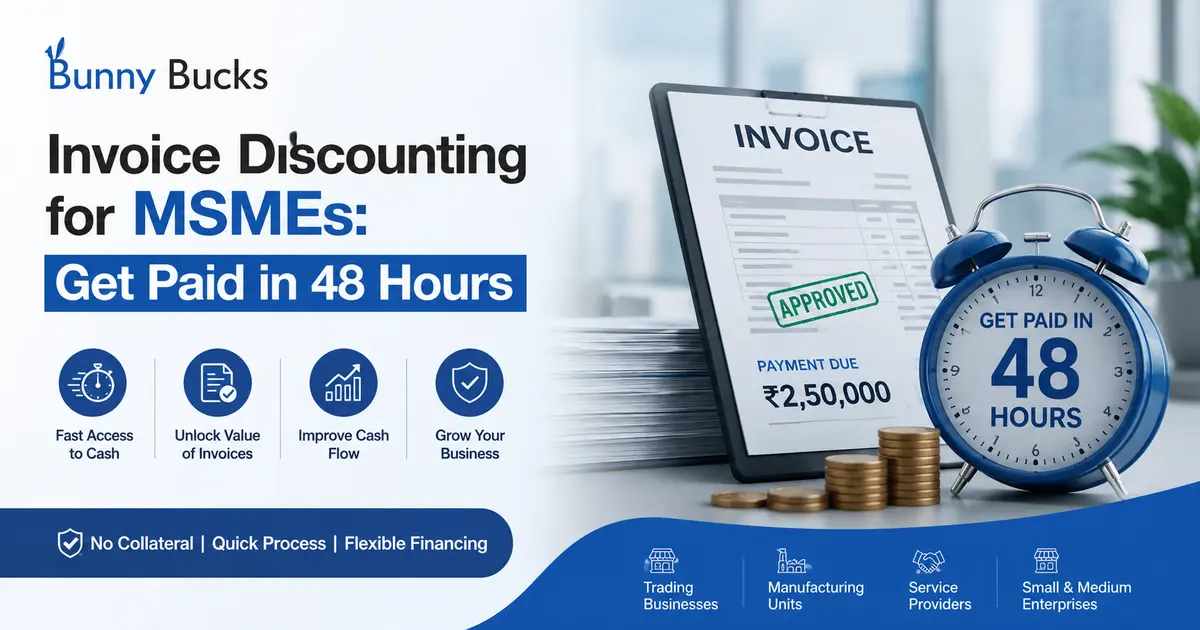
Invoice Discounting for MSMEs: Get Paid in 48 Hours
Invoice Discounting for MSMEs lets you borrow against unpaid customer invoices instead of waiting 30, 60, or 90 days to get paid. You upload your invoice to a platform, a financier bids on it, and you get up to 90% of the invoice value in your account within 24 to 48 hours. The buyer pays the full amount later, directly to the financier.
That's it. No collateral. No long loan queue. No begging your accounts team to "follow up again."
If you run a small manufacturing unit, a trading business, or a services company that supplies to large corporates, you already know the pain. Your buyer sits on a 60-day payment cycle while your raw material vendor wants cash in 15. Invoice discounting closes that gap.
Let's break down exactly how it works, why it beats a business loan, and which platform you should actually trust.
What Is Invoice Discounting, Really?
Think of it as selling your invoice's future value today, at a small discount.
Say you've supplied goods worth ₹10 lakh to a large company. They'll pay in 60 days. You need cash now for salaries and raw materials.
You list that invoice on an Invoice Discounting Platform. A bank or NBFC bids to fund it. You get roughly ₹9.5 lakh instantly. When the buyer pays in 60 days, the financier collects the full ₹10 lakh and keeps the difference as their fee.
You get liquidity. The financier gets a return. The buyer's payment terms don't change at all.
Why MSMEs Are Switching From Loans to Invoice Discounting
Bank loans and cash credit limits are slow, collateral-heavy, and painful to renew every year. Here's a quick comparison.
| Factor | Traditional Bank Loan | Invoice Discounting |
|---|---|---|
| Collateral required | Usually yes | No |
| Disbursal time | 2-4 weeks | 24-48 hours |
| Based on | Your credit history | Buyer's credit strength |
| Repayment pressure | Fixed EMI | Buyer repays financier directly |
| Impact on balance sheet | Adds debt | Off-balance-sheet in many cases |
Because the financing is tied to your buyer's creditworthiness (usually a large, stable corporate), even a young MSME with a thin credit file can raise funds. That's the real unlock here.
RBI-Approved Route: TReDS Platforms
Here's where a lot of MSME owners get confused, and honestly, get scammed too.
(Trade Receivables Discounting System) is the RBI-regulated framework for invoice discounting in India. It's not one company — it's a licensed structure, and only a handful of platforms are authorized to operate under it.
Which Invoice Discounting Platform Is RBI Approved?
As of now, the RBI has licensed platforms including RXIL, M1xchange, and Invoicemart to run TReDS exchanges. Any platform operating outside this list and calling itself "RBI approved" should be treated with caution — verify directly on the before onboarding.
A genuine TReDS platform providing online invoice discounting will always:
- Show you multiple financiers bidding competitively on your invoice
- Never ask for collateral or personal guarantees
- Settle payments through a regulated digital exchange, not a private account
- Be transparent about discounting rates before you accept a bid
How to Get Started With Invoice Discounting for MSMEs
You don't need a finance degree for this. The process is genuinely simple once you understand the four steps.
-
Step 1: Register on a TReDS or Invoice Discounting Platform
You'll need your GST details, buyer information, and basic KYC documents. Registration usually takes a day or two. -
Step 2: Upload Your Approved Invoice
The invoice must be accepted or acknowledged by your buyer. Unapproved invoices don't get funded — this protects the financier and, indirectly, you. -
Step 3: Financiers Bid on Your Invoice
Multiple banks and NBFCs compete to fund it. Lower bidding fees mean more money lands in your account. -
Step 4: Receive Funds, Buyer Repays Later
You get your cash almost immediately. The buyer pays the financier on the due date, and the loop closes.
Bold fact worth remembering: because financiers compete for your invoice on TReDS, discounting rates are often lower than what you'd get through a private lender or factoring company.
Is TReDS Only for MSMEs?
Mostly, yes — TReDS was built specifically to solve the MSME payment-delay problem. Only MSME sellers can discount invoices on TReDS exchanges. Buyers (corporates, PSUs, government departments) and financiers (banks, NBFCs) participate on the other side, but the seller slot is reserved for MSMEs. Large enterprises acting as sellers aren't eligible to raise funds through TReDS.
Frequently Asked Questions
-
How fast can I get funds through invoice discounting?
-
Does invoice discounting affect my credit score?
Generally no, because the funding is based on your buyer's credit profile, not yours. It also doesn't sit on your books as a traditional loan in most structures.
-
What percentage of the invoice value do I actually receive?
Typically 80% to 90% upfront, with the balance (minus financing fees) settled once the buyer clears full payment.
-
Is my buyer informed when I discount an invoice?
Yes. Your buyer needs to acknowledge the invoice on the platform for financiers to bid on it — this is a core part of the TReDS process.
-
Can a new MSME with no credit history use TReDS?
Yes, because eligibility depends heavily on the buyer's creditworthiness, not yours. This is exactly why TReDS works so well for young MSMEs.