Bunny Bucks stands out for its wide financier network, fast onboarding process, and quick invoice turnaround times — giving MSMEs access to competitive discounting rates without the delays typical of traditional financing channels.

TReDS Platform India: Reduce Payment Delays & Improve Cash Flow
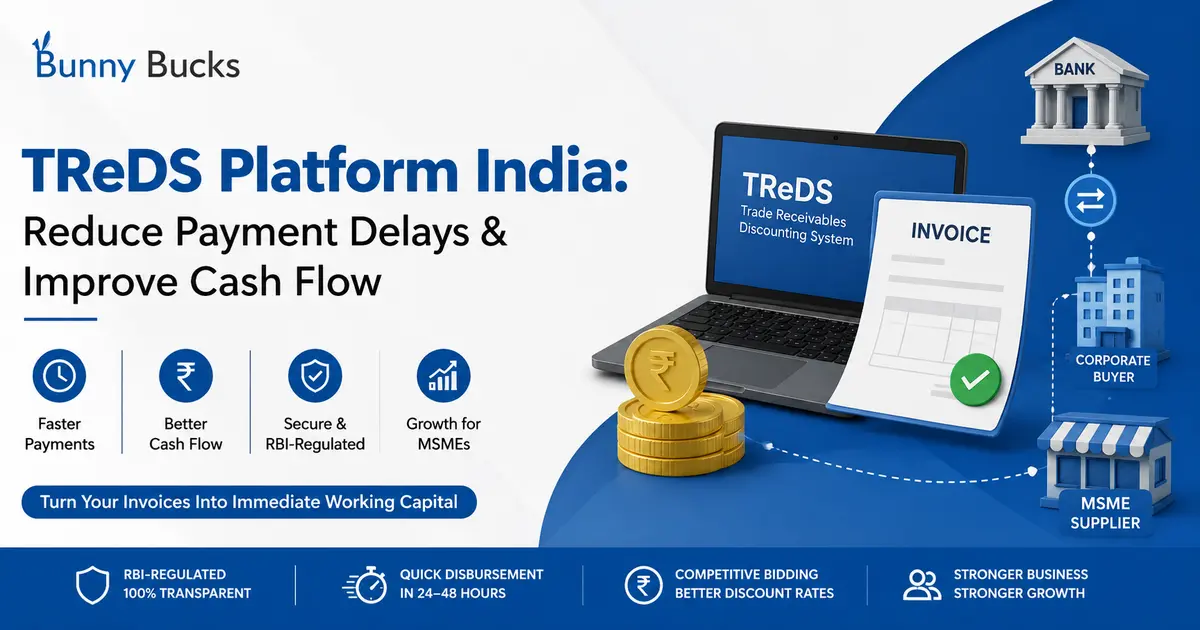
For most small and medium businesses in India, the biggest obstacle to growth isn't a lack of orders — it's cash flow. MSMEs routinely wait 60 to 90 days (sometimes longer) to get paid by large corporate buyers, even after delivering goods or services in full. That gap forces many small suppliers into expensive informal borrowing just to keep operations running.
The TReDS platform India was built to close exactly this gap. Backed by the Reserve Bank of India, TReDS (Trade Receivables Discounting System) is quickly becoming the backbone of modern MSME financing — and understanding how it works is the first step to using it to your advantage.
What Is TReDS?
TReDS stands for Trade Receivables Discounting System, an RBI-regulated electronic platform that allows MSMEs to convert their unpaid invoices into immediate cash. Instead of waiting for a corporate buyer's payment cycle to complete, a supplier can upload the approved invoice to a treds platform, where multiple banks and financiers bid to discount it.
Three parties make the system work:
- MSME sellers – small businesses looking for early payment on invoices
- Corporate buyers – large companies that have accepted the goods/services and approved the invoice
- Financiers – banks and NBFCs that bid to purchase the receivable at a discount
Because the RBI regulates every TReDS platform in India, the entire process is transparent, standardized, and free of the informal middlemen that traditionally squeeze small suppliers on interest rates.
How the TReDS Platform Works for MSME Suppliers in India
The mechanics are straightforward. Once a corporate buyer confirms an invoice is valid:
- The MSME uploads the invoice to the treds platform for msme suppliers india
- Multiple financiers view the invoice and place competitive bids
- The MSME accepts the best rate offered
- Funds are disbursed — often within 24 to 48 hours
- The financier collects the full invoice amount from the corporate buyer on the due date
This flips the traditional financing model on its head. Instead of an MSME approaching one bank and negotiating from a position of limited leverage, multiple financiers compete for the business — which naturally drives down the discounting cost.
TReDS Bill Discounting India: The Core Mechanism
At the heart of TReDS is treds bill discounting india — essentially invoice factoring made digital, competitive, and regulated. Rather than negotiating a loan against collateral, the MSME is simply selling a confirmed receivable at a small discount in exchange for immediate liquidity.
Because financiers bid against each other in a live auction, discounting rates on TReDS are typically far more competitive than a standard working capital loan or overdraft facility. There's no lengthy loan application, no collateral requirement, and no dependency on the MSME's own credit history — the invoice itself, backed by a large corporate buyer, is the security.
TReDS Without Recourse: What MSMEs Need to Know
One of the most important — and most misunderstood — features of TReDS is the "without recourse" structure.
TReDS without recourse meaning for MSMEs: once an invoice is discounted without recourse, the MSME is no longer liable if the corporate buyer fails to pay on the due date. That risk shifts entirely to the financier who purchased the receivable.
This is a major advantage over traditional invoice discounting arrangements, where the MSME often remains on the hook if the buyer defaults. On TReDS, without-recourse transactions let small suppliers offload payment risk completely — a critical protection given how much working capital MSMEs stake on large orders.
| Feature | With Recourse | Without Recourse |
|---|---|---|
| Risk if buyer defaults | Falls back on MSME | Stays with financier |
| Typical use on TReDS | Rare | Standard |
| MSME risk exposure | Higher | Minimal |
TReDS Registration for MSMEs in India: Step-by-Step
Getting started requires a few straightforward steps:
- Confirm eligibility — the business must hold valid Udyam/MSME registration
- Choose a platform — compare the different TReDS platforms in India for fees, financier network, and turnaround time
- Submit documentation — GST registration, PAN, bank details, and MSME certificate
- Get your corporate buyer onboarded — the buyer must also be registered on the same platform to approve invoices
- Start uploading invoices once verification is complete
The most common bottleneck in TReDS registration for MSMEs in India isn't the seller's paperwork — it's getting the corporate buyer onboarded and actively approving invoices on the platform. It's worth confirming your key buyers are already active on a TReDS platform before you register.
TReDS Onboarding for Large Corporates in India
Corporates benefit from TReDS just as much as their suppliers do. TReDS onboarding for large corporates in India has also been accelerated by regulation — companies above a specified turnover threshold are now required to onboard onto a TReDS platform, ensuring MSME vendors are paid promptly and transparently.
Beyond compliance, corporates gain:
- Stronger, more reliable supplier relationships
- Reduced administrative back-and-forth over payment delays
- Better visibility into payables and vendor cash-flow health
Comparing TReDS Platforms in India
Not all TReDS platforms in India offer the same experience. When evaluating options, MSMEs and corporates should look at:
- Financier network size — more financiers bidding typically means better rates
- Onboarding speed — how quickly sellers and buyers can get verified and active
- Turnaround time — how fast invoices are discounted once approved
- Platform support — responsiveness for disputes, technical issues, or documentation queries
Why TReDS Is the Future of MSME Financing
India's push toward formal, transparent MSME credit is only accelerating. Government policy increasingly favors platforms like TReDS over informal lending, and as more corporates are mandated to onboard, the pool of financiers and available liquidity keeps growing. For MSMEs, that means faster access to working capital, fairer pricing through competitive bidding, and dramatically reduced dependency on high-cost informal credit.
As digitization deepens across India's financial ecosystem, TReDS is positioned to become the default channel for receivables financing — not a niche alternative, but the standard way MSMEs get paid.
Ready to fix your cash flow gaps? Talk to BunnyBucks about MSME financing options and find out which TReDS platform fits your business in under 10 minutes.
Frequently Asked Questions
-
Why is Bunny Bucks considered one of the best TReDS platforms in India?
-
Who can use the best TReDS platform?
Any MSME with valid Udyam registration can register as a seller, while large corporates (particularly those above the mandated turnover threshold) can onboard as buyers. Banks and NBFCs participate as financiers bidding on invoices.
-
How fast is invoice discounting on the best TReDS platform?
Once a corporate buyer approves an invoice, discounting and fund disbursement typically happen within 24 to 48 hours — significantly faster than conventional loan or overdraft processes.
-
How does the best TReDS platform improve MSME cash flow?
By converting approved invoices into immediate cash instead of waiting out 60-90 day payment cycles, MSMEs can reinvest in operations, meet payroll, and take on new orders without relying on expensive informal credit.